
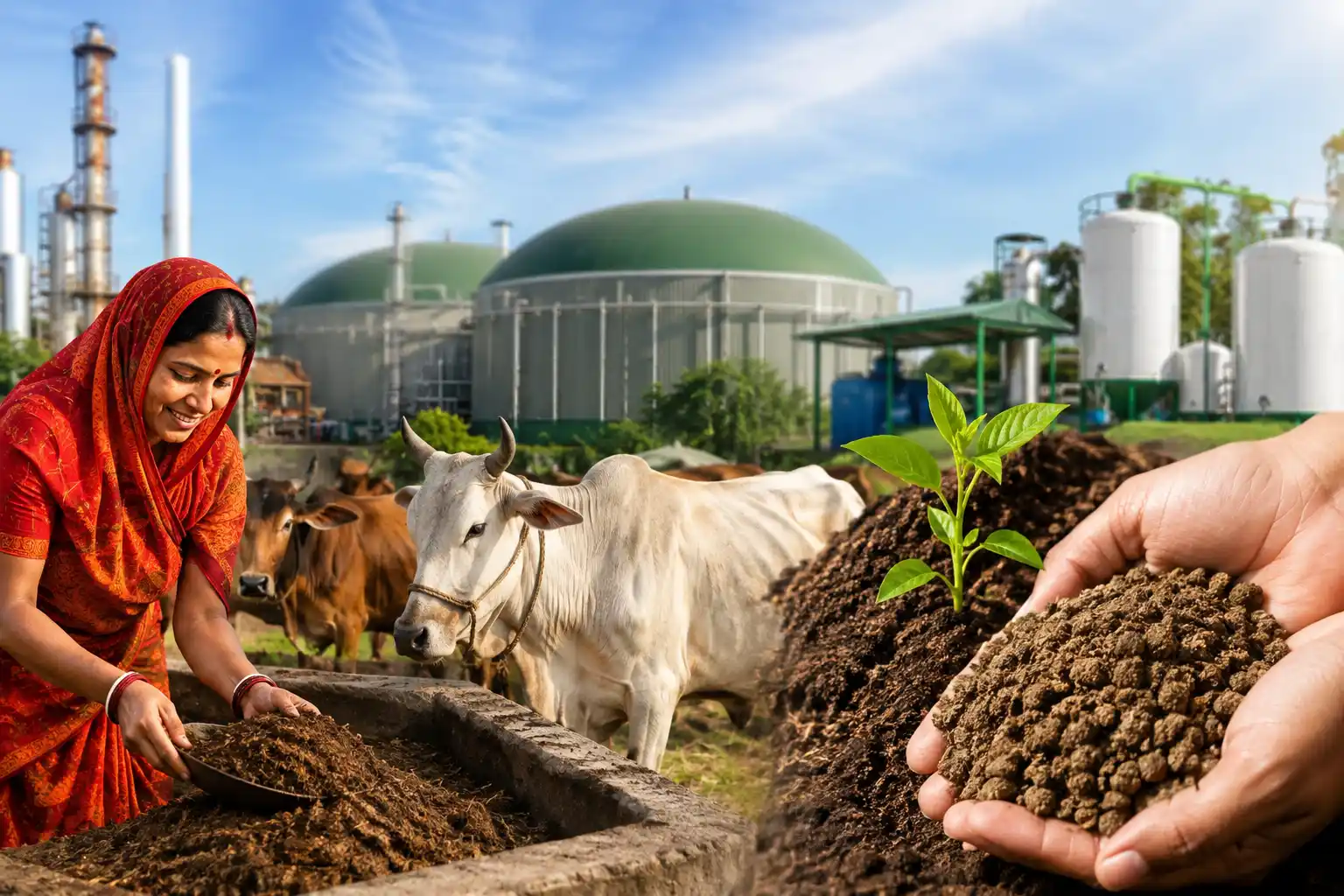
GOBARdhan Scheme 2026: Complete Guide to the ₹23,731 Crore National Circular Bioenergy Mission
In a landmark decision to accelerate India’s clean energy transition and bolster the rural economy, the Union Cabinet has officially approved the GOBARdhan Scheme (National Circular Bioenergy Scheme) with a massive financial outlay of ₹23,731 Crore (approximately $2.5 Billion).




Spanning a 10-year implementation timeline from FY 2026-27 through FY 2035-36, this flagship initiative aims to scale up India’s Compressed Biogas (CBG) production by tenfold. By turning agricultural waste, animal dung, and municipal solid waste into valuable bioenergy, the scheme bridges the gap between rural economic growth and national energy independence.
For comprehensive coverage on government policies and economic reforms, explore our Sarkari Yojana section.
Key Financial & Technical Overview
| Parameter | Operational Details |
| Scheme Name | GOBARdhan (Galvanizing Organic Bio-Agro Resources Dhan) |
| Official Framework | National Circular Bioenergy Scheme |
| Approved Budget | ₹23,731 Crore |
| Implementation Period | FY 2026-27 to FY 2035-36 (10 Years) |
| Nodal Ministry | Ministry of Petroleum and Natural Gas (MoPNG) |
| Primary Output | Compressed Biogas (CBG) & Fermented Organic Manure (FOM) |
| Target Jobs | 1,50,000 Direct & Indirect Positions |
| Estimated Forex Savings | ₹40,000 Crore in Reduced LNG Imports |
What is the GOBARdhan Scheme?
The GOBARdhan Scheme operates on a circular economy framework: converting organic waste into renewable fuel. Rather than letting farm stubble burn or cattle dung decompose openly—releasing harmful greenhouse gases—the scheme establishes commercial-scale anaerobic digestion plants across rural and semi-urban India.
How Compressed Biogas (CBG) is Produced:
- Feedstock Collection: Agri-waste (crop stubble), cattle dung, press mud from sugar mills, and municipal bio-waste are aggregated.
- Anaerobic Digestion: Organic matter breaks down in sealed digesters without oxygen, generating raw biogas (60% methane, 40% CO₂).
- Purification & Compression: CO₂ and hydrogen sulfide are removed to achieve over 90% methane concentration, purifying it into grid-grade CBG identical to commercial CNG.
- By-Product Utilization: The nutrient-rich liquid and solid residues are processed into Fermented Organic Manure (FOM) for agricultural soil nourishment.
Stay updated on how green energy investments are shaping domestic markets in our Business News segment.
The 6 Core Growth Pillars of GOBARdhan 2026
To tackle historical bottlenecks in the bioenergy sector—such as unpredictable pricing, high capital costs, and feedstock supply chain disruptions—the Cabinet has established six operational pillars:
                  ┌─────────────────────────────────────────┐
                  │        GOBARdhan 2026 Framework         │
                  └────────────────────┬────────────────────┘
                                       │
        ┌──────────────────────────────┼──────────────────────────────┐
        ▼                              ▼                              ▼
  1. Blending Mandate          2. Fixed Price Support         3. Capital Grants
  (5% CBG in CGD Grid)         (₹2,110 / MMBTU Rate)          (₹2 Cr / TPD Subsidy)
        │                              │                              │
        ├──────────────────────────────┼──────────────────────────────┤
        ▼                              ▼                              ▼
  4. Pipeline Connect          5. Credit Guarantees           6. Challenge Fund
  (Direct Gas Injection)       (Collateral-Free Loans)        (District Biomass Maps)
1. Mandatory CBG Blending Targets
City Gas Distribution (CGD) entities are now legally mandated to blend CBG into their Natural Gas networks:
- FY 2026-27: 3% mandatory blending
- FY 2027-28: 4% mandatory blending
- FY 2028-29 onwards: 5% mandatory blending
2. Long-Term Price Certainty
To guarantee financial returns for plant operators, the government has set an Administered Price Mechanism (APM) of ₹2,110 per MMBTU, fixed for 10 years. This protects producers from global fossil fuel price volatility.
3. Capital Subsidy Support
- Greenfield (New) Plants: Capital assistance of up to ₹2 Crore per Tonne Per Day (TPD) of installed capacity.
- Brownfield (Expansion) Units: Financial grants to upgrade existing basic biogas plants into high-efficiency CBG units.
4. Gas Grid Pipeline Connectivity
Subsidies will cover up to 50% of the cost of laying dedicated pipeline connections between rural CBG plants and national gas trunk pipelines, eliminating the need for heavy truck transportation.
5. Credit Guarantee Mechanism
A dedicated credit risk fund will enable MSMEs, farmer producer organizations (FPOs), and young entrepreneurs to secure collateral-free bank loans for plant construction.
6. District Biomass Challenge Fund
Each district will receive targeted funding to perform GIS-based biomass mapping, establish feedstock storage centers, and deploy machinery like balers and rakes.
Dual Economic Benefits: Empowering Farmers & Industry
1. Direct Income Boost for Farmers
Farmers no longer view agricultural residue as waste. Through local collection hubs, farmers can sell crop stubble and cattle dung directly to CBG plant operators, creating a reliable second income stream and curbing the need for stubble burning.
2. Soil Health Restoration Through Organic Manure
Chemical fertilizer overuse has depleted soil organic carbon across many agricultural belts. The by-product of CBG production—Fermented Organic Manure (FOM)—provides an eco-friendly, carbon-rich bio-fertilizer that improves soil water retention and reduces reliance on imported chemical fertilizers.
For more policy breakdowns affecting rural communities, visit Talkaaj Media.
Environmental & National Economic Impact
- Reduced Import Dependency: By expanding domestic CBG production, India expects to save ₹40,000 Crore in foreign exchange over the next decade by substituting imported Liquefied Natural Gas (LNG).
- Massive Job Creation: The bioenergy supply chain—including harvesting, aggregation, logistics, plant operations, and bio-fertilizer marketing—is projected to generate over 1,50,000 skilled and semi-skilled jobs.
- Carbon Emission Reductions: The scheme will abate millions of tonnes of carbon emissions annually, contributing directly to India's target of achieving Net-Zero carbon emissions by 2070.
Frequently Asked Questions (FAQs)
Q1. Who can apply to establish a CBG plant under the GOBARdhan Scheme?
Individual entrepreneurs, private companies, Farmer Producer Organizations (FPOs), agricultural cooperatives, and Municipal Corporations are all eligible to apply for setup subsidies and credit guarantees under the scheme.
Q2. How does GOBARdhan help reduce stubble burning?
Instead of burning paddy straw (parali) in fields, farmers can collect and sell baled stubble to CBG plants as a primary raw material, turning an environmental hazard into a profitable crop residue business.
Q3. Is CBG safe for regular CNG vehicles?
Yes. Compressed Biogas (CBG) is calorifically equivalent to Compressed Natural Gas (CNG), containing over 90% pure methane. It can be used directly in existing CNG vehicles without any engine modifications.
Conclusion
The GOBARdhan Scheme 2026 represents a transformative shift in India’s approach to energy security, waste management, and rural prosperity. Backed by a robust ₹23,731 Crore budget and a clear 10-year regulatory roadmap, the mission establishes a sustainable bio-economy that benefits farmers, green energy developers, and everyday consumers alike.
Stay tuned to Latest India News on Talkaaj Media for real-time updates on policy announcements, environmental initiatives, and economic developments.